
Bricks
The following excerpt will be placed near the beginning of my memoir-in-progress -- perhaps even as the starting point.

Every story unfolds, and can be told, from myriad starting places. Depending on where the thread is picked up, there will be variations in voice and echo; in the flow of ripples going out; in the particular cast of light—bright, shimmering, or shadowy. Images may be clearly etched, or blurred, or erased. Does the same story result?
...I dreamed a picture of the story as a tree: from unseen roots reaching deep into the earth (our unknown past) a sturdy trunk (the linear narrative of facts and dates) rises straight up toward the sky. From the trunk grow many branches (events and relationships that flesh out the story) and on those branches hang leaves, flowers, nuts and other fruits of growth (sketches, letters, personal notes, photographs)—like candles on the tips of boughs, lit to illuminate the entire tree.
I reach back into the dimming past, through a tangle of key events...and pull up the year 1984 as the place to begin my story. I was thirty-seven years old, married, with two children under six. My parents had been recently divorced and the house I grew up in was about to be sold. On a blistering hot summer day, my seven siblings and I—with boyfriends, girlfriends, spouses, and babies in tow—congregated at the old brick homestead to take away as much of our childhood as we could cram into assorted beat-up VW Beetles and pickup trucks. In my mind’s eye I see Grandfather Dingman’s medical instrument cabinet dangling from the third floor window on a rope, descending precariously inch by inch, the two glass doors swinging open and closed, occasionally bumping against the brickwork on the way down.
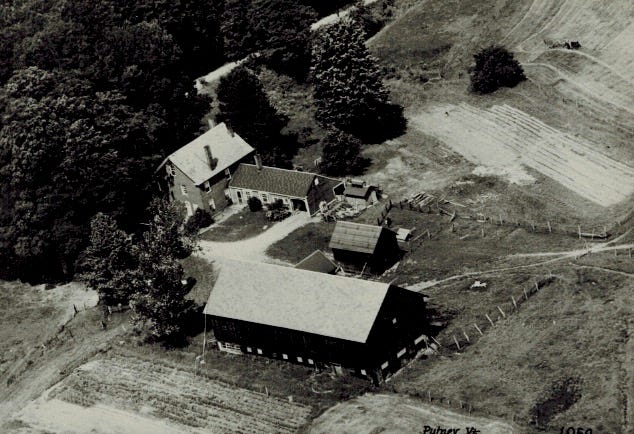
My parents’ passionate and romantic relationship had begun in 1940, when they met at the American Friends Service Committee work camp where Dad was doing alternative service as a conscientious objector. They were young—Mom nineteen, Dad twenty-four. Two years later, after the birth of their first child, they followed their dream of raising a large family on back-to-the-land principles. They purchased an old brick farmhouse from an ancient Vermonter, who apparently proved rather hard to dislodge, returning day after day “to look for something.” Mom, with her soft and giving heart, fed him many a meal and knit him a warm sweater. Meanwhile she and Dad went to work restoring the house, which was in desperate need of cleaning out, rebuilding, and plumbing.
Eight of us grew up in that house—several born in the downstairs bedroom. Dad carved and printed a birth announcement proclaiming the arrival of each new child. Between babies, Mom wrote picture books, which Dad illustrated, working in his third-floor studio, where we kids were almost always welcome.
I loved wandering around that room looking at everything while Dad worked at his desk. One whole wall was a bulletin board, covered with book ideas, sketches, and business letters, tacked in place by pushpins with clear glass heads. On the counters there were stacks of books, tubes of paint, brand new pencils, and outgoing artwork—packaged in brown paper, tied with string and addressed in Dad’s elegant writing. I remember one December day when I was 7 or 8, when Dad suddenly looked up from his work and caught me staring speechless at a pile of wrapped packages, all neatly labelled “from Santa” in the same script. He shooed me out of the room, but my world view was already changed.
Dad taught by example the deep satisfaction in making things. Even hasty notes and letters were adorned with sketches, usually of a humorous nature. He designed his own letterheads and business cards, as well as those for others in the family.
In his third-floor studio, we were taught many arts: paper marbling, figure drawing, hand bookbinding, and block-printing, to name a few. Following the tradition established by him and his parents before him, we designed and printed our own Christmas cards. My brother Peter, at age seven, even printed up a stack of counterfeit dollar bills, which for some reason caused the local merchants no end of mirth when he went in to make his first purchases.
Eventually Dad outfitted the door at the bottom of the studio stairs with a hook and eye. That way, when working on an imminent deadline, he could foil the constant intrusions of children in search of drawing paper, bicycle repairs, or arbitration in sibling disputes.
For thirty-five years our parents worked from home, writing and illustrating books to provide for their growing family. Each of us was schooled at home for at least one year. It seems the decision was made on an individual basis, depending on a particular child’s temperament, the reputation of the public school teacher for the grade in question, and probably other factors that we kids had no inkling of.
We were all expected to contribute to the working of the small farm, feeding animals, milking goats, helping with haying, growing a huge garden, harvesting and putting food by—as well as cooking, helping with younger children, and pulling our own weight in all other aspects of running a large household. In our free time—which was ample and unsupervised—we were at liberty to roam the land at will, all the way down to the Connecticut River on one side, and the town of Putney on the other.
Now, years later, the long, hot day of clearing out the house came to an end. The sun dropped low in the sky and long shadows reached up the rose-colored side of the building. One by one our little caravan drove away, each ramshackle vehicle with a hodge-podge of old chairs and dollhouses strapped to the roof. The house, the barn, and the surrounding land would henceforth be the stuff of memory and recurring dreams.
                 EARTH

I never drive south on 91
without a glance to the right
just before the Putney exit,
hoping to find a certain chimney
still visible above the trees—
and when I do my heart
flies straight to it

for I grew up in that house
made of the earth on which it stands:
brick two centuries old in hues
of salmon, pink, and coral,
steep grey roof of layered slate,
granite sills peppered white and black,
the walkway a single slab of stone
laid from hitching post to front door—

village folk once square-danced
over the wide boards of the third floor
that became our father’s studio,
where he drew pictures for the books
mother wrote, baby at her breast,
and we were free to roam
the many-chaptered landscape
of those hundred acres—

the dark soil of ancient riverdrift,
worked fine by wagon wheels,
the scratching of hens, childrens’ feet,
and the nimble hooves of young goats
brought forth not only vegetables—
plenty to last a family of ten all winter—
but a steady crop of olden treasure besides:

blue and white china shards,
an iron bell dated 1622,
square nails and old spoons,
ladies’ high-topped button boots,
and best of all, an iridescent glass bowl
dug up with the potatoes,
scrubbed and presented
to Grandmother on her birthday—

where the brickyard used to be,
we lay belly-down on the banks
of the sunlit brook, reaching
through clumps of wild mint
into cold water, bare fingers
mining the same veins of silky clay
the bricks of our house came from,
and we rolled and pinched it
into whatever shapes we fancied

and when I was nine
I made a brick with my hands
pressing soft clay into a wooden mold
and letting it dry in the sun—
then my father drove me and my brick
north to Lebanon where it was fired
with stacks of others in a beehive oven
and it came out red and solid
and real, to sit forever after
high on the chimney ledge
in the company of its ancestors
Astonishingly vivid. I LOVE this excerpt. I want to read on and on !!!!! <3 <3 <3 <3
Clydie -- it is truly amazing to read this and know that this really is the way we grew up. What a gift our parents gave us.