
Walking
... is an invitation to die standing up ... it reminds us of our finiteness ... bodies heavy with needs, nailed to the ground ... [Frédéric Gros]

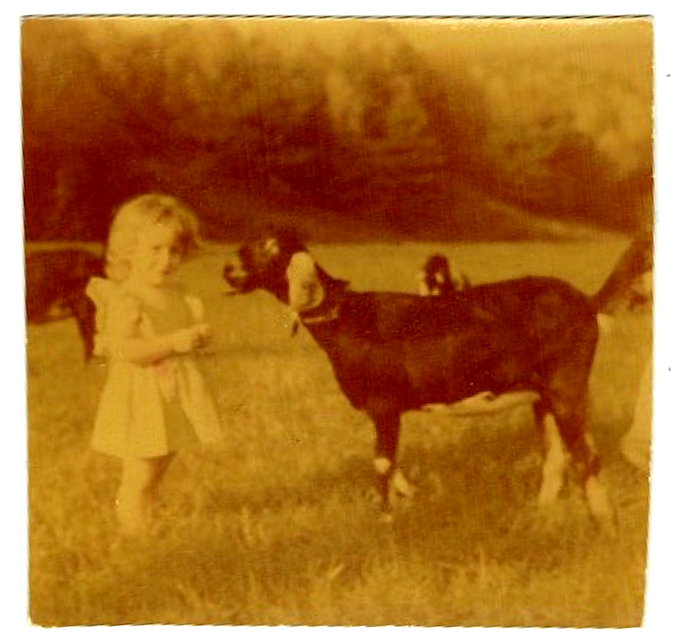
My earliest recollection of a customary walk is of walking with goats when I was very small. My mother and I would pass through a gate and into the expansive meadow where our small herd of Nubian goats spent the day grazing. Spotting us, the goats would come towards us to join our leisurely and dreamlike wander. My favorite walking formation featured me walking sandwiched between two goats, a hand resting on each fragrant, sun-warmed back, live animal energy tingling up my arms. I remember a subliminal sensation that my mother’s thoughts were faraway, her response to any question being delayed and vague.
That sense of animal connection to the Earth — the expansiveness of ground and sky, of time and possibility — has stayed with me all my life. Solitary walks remain a key feature of my daily practice today. Whether along alpine trails, the streets of Florence, deep in a wooded glen, or along the ocean’s edge — when the outdoors invites, I accept. Walking is the best way to start and end every day. And in between, when pressures weigh and nothing’s going right, walking is the answer.
Among the many ancient books from my parents’ library, many published before even my grandparents’ time, I’ve recently become intrigued by the one shown below, published in 1836. Written by Donald Walker, a British writer and advocate for physical education, Walker’s Manly Exercises is subtitled “Containing rowing, sailing, riding, driving, racing, hunting, shooting, and other manly sports.”
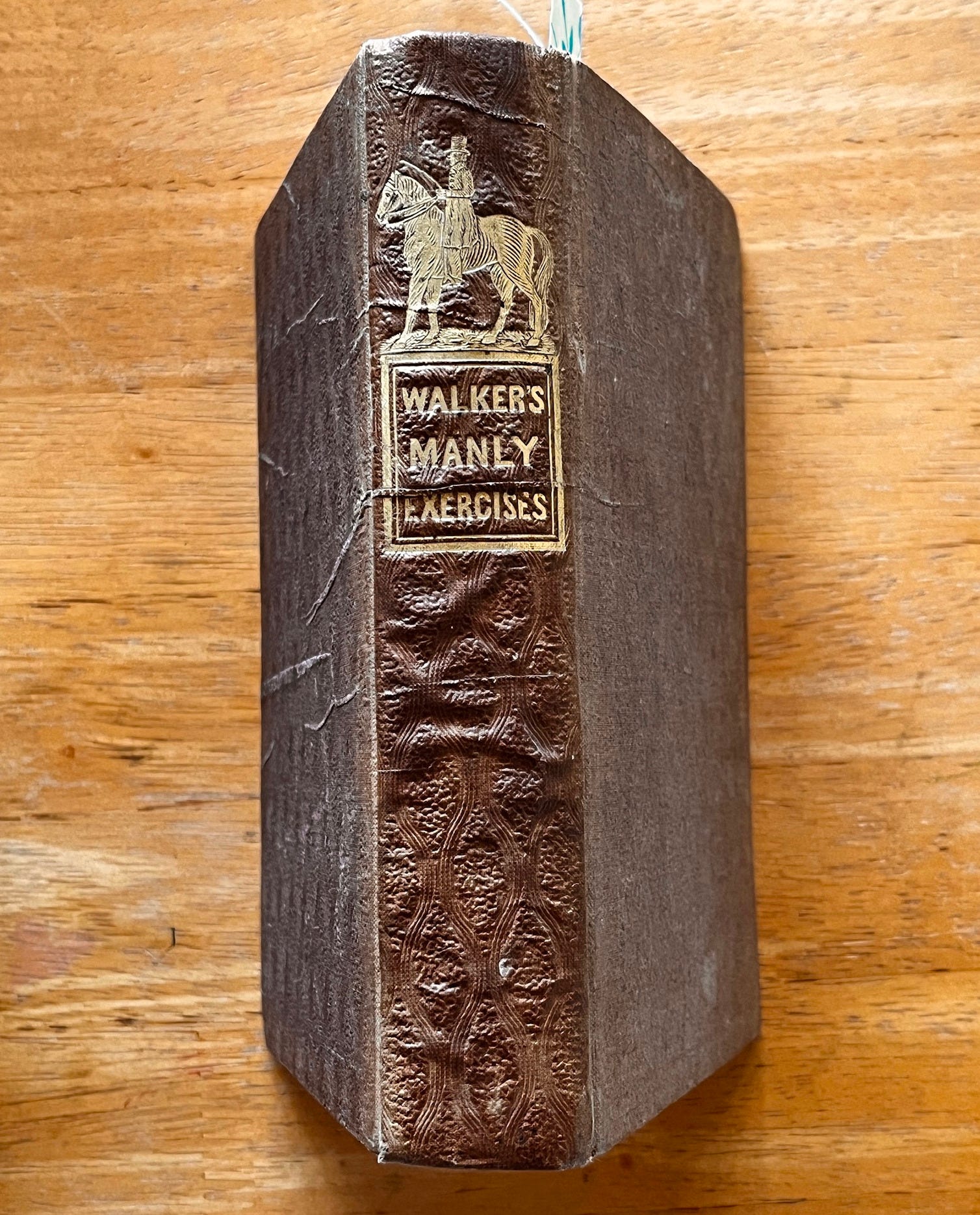
It was followed a year later by a volume titled Exercises For Ladies, subtitled “calculated to preserve and improve beauty AND to prevent and correct personal defects, inseparable from constrained or careless habits.” There are sections on topics like the correct posture while writing, or playing the pianoforte or harp, and even lying in bed! among many other pastimes deemed suitable for young women.
Walker’s Manly Exercises is an early Victorian guide to physical training and practice of the numerous sports considered appropriate for the cultured young man. Besides detailed instructions for many active pursuits, it also includes sections which today might be labelled ‘trouble-shooting’ There are, for example, tips on Accidents To Coaches and Accidents to Horses. In the chapter on SKATING, a lugubrious paragraph is titled Restorative Means, If Apparently Drowned. That chapter closes with a terse two lines under the heading If Apparently Dead From Intense Cold.
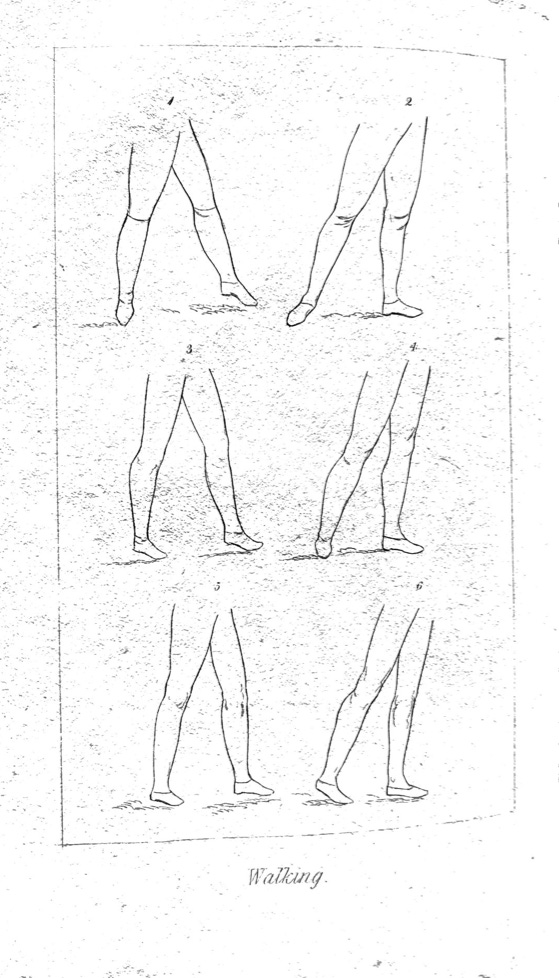
Author Walker defines walking this way:
“Of all exercises, walking is the most simple and easy. The weight of the body rests on one foot while the other is advanced; it is then thrown upon the advanced foot, while the other is brought forward; and so on in succession … The utility of walking exceeds that of all other modes of progression. While the able pedestrian is independent of stage coaches and hired horses, he alone fully enjoys the scenes through which he passes, and is free to dispose of his time as he pleases … In relation to health, walking accelerates respiration and circulation, increases the temperature and cutaneous exhalation, and excites appetite and healthful nutrition. Hence, as an anonymous writer observes, the true pedestrian, after a walk of 20 miles, comes into breakfast with freshness on his countenance, healthy blood coursing in every vein, and vigor in every limb, while the indolent and inactive man, having painfully crept over a mile or two, returns to a dinner which his stomach cannot digest.”
My explorations into the pursuit of walking led me to a recent brilliant and intriguing book that I’m still reading my way through: A Philosophy of Walking, by French philosopher Frédéric Gros, published in 2008.
Frédéric Gros (b. 1965) is Professor of Philosophy at the University of Paris-XII and the Institute of Political Studies (Sciences-Po) of Paris. (An interview in The Guardian here). His book is a brilliant ramble through many aspects of walking, and also talks about other thinkers who considered walking a central part of their practice — Thoreau, Rimbaud, Nerval, Nietzsche, and Kant, among others.
Rather than focussing on the methods of ‘correct’ walking, the book is devoted to the physical/emotional/spiritual aspects of walking: what motivates a person to walk, what is received in the act of walking, the purpose of the activity in a person’s daily life. Sample chapter headings are: Freedoms; Slowness; Solitudes; Gravity; Energy; Walking As a Form of Madness; Silences. The language is poetic, and certain passages even seem to embody the rhythm of walking. I can’t recommend this book highly enough. Some of my favorite passages so far are these:
On Slowness: “But haste and speed accelerate time, which passes more quickly, and two hours of hurry shorten a day. Every minute is torn apart by being segmented, stuffed to bursting. You can pile a mountain of things into an hour. Days of slow walking are very long: they make you live longer, because you have allowed every hour, every minutes, every second to breathe, to deepen, instead of filling them up by straining the joints. Hurrying means doing several things at once, and quickly: this; then that; and then something else. When you hurry, time is filled to bursting, like a badly-arranged drawer in which you have stuffed different things without any attempt at order.”
On Energy: “Walking, by virtue of having the earth’s support, feeling its gravity, resting on it with every step, is very like a continuous breathing in of energy. But the earth’s force is not transmitted only in the manner of a radiation climbing through the legs. It is also through the coincidence of circulations: walking is movement, the heart beats more strongly, with a more ample beat, the blood circulates faster and more powerfully than when the body is at rest. And the earth’s rhythms draw that along, they echo and respond to each other.”
“A last source of energy, after the heart and the Earth, is landscapes. They summon the walker and make him at home: the hills, the colours, the trees all confirm it. The charm of a twisting path among hills, the beauty of vine fields in autumn, like purple and gold scarves, the silvery glitter of olive leaves against the defining summer sky, the immensity of perfectly sliced glaciers … all these things support, transport and nourish us."
Gros is a specialist in the work of Michel Foucault (1926-1984). Foucault was a philosopher, historian, and social theorist whose writings delved into the relationships between power, knowledge and liberty, and how they are used as a form of social control. As an editor of Foucault's papers, Gros has devoted much of his career to Foucault's legacy. So it comes as no surprise that Gros also eloquently explores the role of walking within the framework of political activism.
In the chapter titled “Walking Together: The Politics of Celebration” he speaks of collective protest marches, referencing the Long March of Mao’s troops (1934 - 35), and the 1963 March on Washington as historical precedents. He contrasts the stiff, machine-like marches of regimented troops with the free-form, organically-coordinated motion of a protest march — a multitude of people amassing and walking together “… without any drum rolls but with their power in numbers: a generous swell, a simple and calm wave like in the Pelizza da Volpedo painting Il Quarto Stato.”
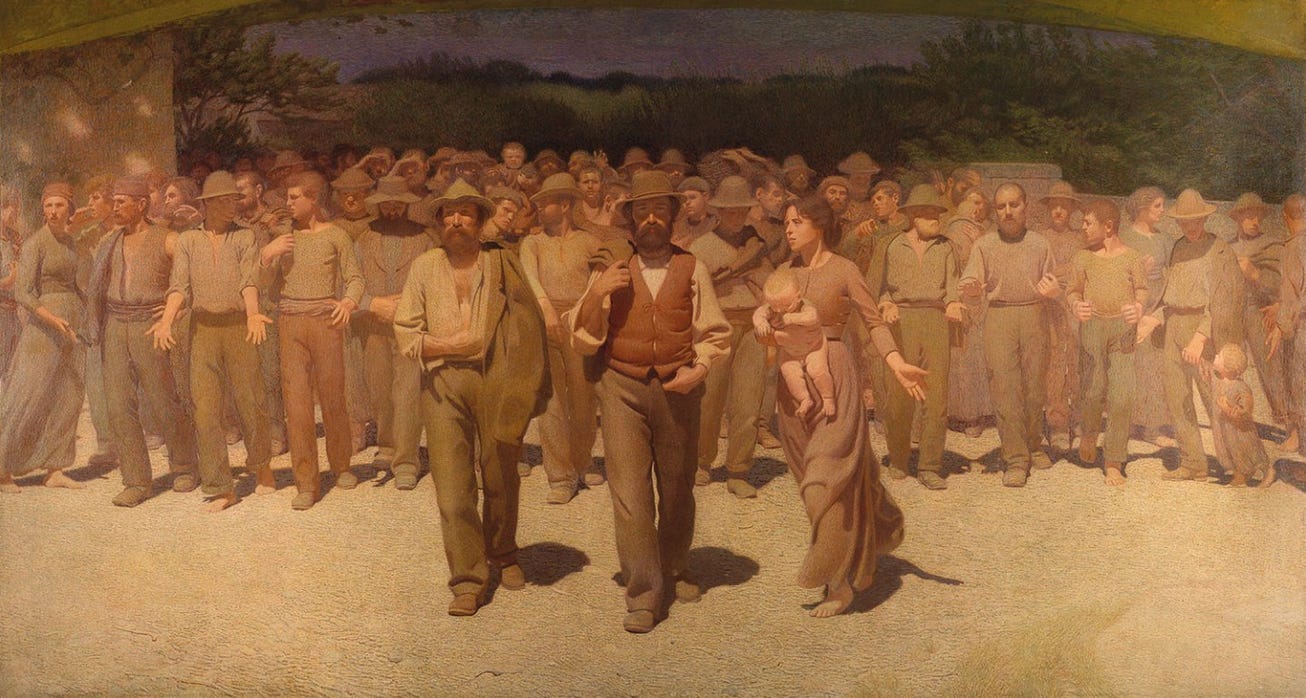
He likens the movement of this massive gathering of protesters to the huge flocks of starlings that philosopher-pacifist Alain describes in his Remarks on Religion:
“They move like a single being, even though each is bound up in their own fantasies. They spread out at the edges but then come together again as if connected by elastic bands…
“The ensemble undulated like a piece of fine cloth. No sign of any leader; it was the whole that was governing the parts, or rather each individual bird was both giving and receiving instructions.” [Alain, Remarks on Religion]
Gros goes on to observe that “these dancing compositions are the symbol of the other order: a non-military and spontaneous order that is at the root of every collective action.”
He talks about the power inherent in the calm, determined swell of a huge number of citizens coming together, a festive anti-establishment assembling to lay claim to and defend their rights. He sees this walking together as a celebration.
“And that is what rulers are afraid of: that a people will discover the sheer joy of being together, that they will rediscover their shared humanity through their power in numbers, and they will experience in their embracing of a cause the pleasure of solidarity and of acting in their common interest.”
The last chapter of Gros’s book is called A Quest For Weariness and he ends the book with a final comforting image: “The magic of walking lies in the unproductive repetition of putting one foot in the front of the other: of rediscovering a reasonless reason for carrying on. Our step sets the rhythm for our breathing, and in return our breath delivers the energy we need. This gently wears away at the body as if it were being polished, resulting in a radiant weariness. In the evening, the body, like a faithful dog overcome with fatigue, curls up at the foot of the soul and falls asleep, serenely, knowing that its rest is well deserved.”
And so I shall continue on, my days book-ended by two favorite excursions: the dawn walk, just as the sun bursts on the scene and every blade of grass, every wave and pebble trembles in its light while birdsong shimmers and a soft pattering sprinkle of cooling rain might be heard and felt: the world awaits. And then there is the walk at the close of day — thrush song burnishing the changing colors of the sky, the last rabbit scuttling home into the bushes, nature settling.
Walk Before Dawn
The path through the woods
shows faint and grey —
snow? or moonlight
on bare ground. Tiny sounds:
one leaf rubbing another,
an owl shifting on the branch.
A startling whoosh of wings
through trees: grouse rising.
Walking without fear,
alert but confident,
shoes sharing a worn path
with paws and hooves.
—Clyde Watson
On a recent visit to Providence RI, I walked the city streets near my lodging and one morning spotted an admirable walker on the other side of the street. I was touched by the sight:
Before you start the video below, take note of the gentleman who starts out half-hidden behind the red post. Keep your eye on his progress, as traffic continues to hurtle past him going in the opposite direction …
I was inspired, watching this man on what I sensed is perhaps a daily expedition. I admired not only by his perseverance in walking despite obvious limitation, but the way he was impeccably dressed, down to the folded white handkerchief peeking from the breast pocket. At the corner crosswalk, he paused and waited for the lights to change, then we both crossed, strangers passing & greeting each other midway. Once on the other side, I turned to see where his path would continue on. But he turned around, crossed back to the other side the way he had come, and very purposefully began to retrace his steps, empty shopping bag still flapping at his side.
Rainwalkers, by Denis Levertov
An old man whose black face
shines golden-brown as wet pebbles
under the streetlamp, is walking two mongrel dogs of dis–
proportionate size, in the rain,
in the relaxed early-evening avenue.
The small sleek one wants to stop,
docile to the imploring soul of the trashbasket,
but the young tall curly one
wants to walk on; the glistening sidewalk
entices him to arcane happenings.
Increasing rain. The old bareheaded man
smiles and grumbles to himself.
The lights change: the avenue’s
endless nave echoes notes of
liturgical red. He drifts
between his dogs’ desires.
The three of them are enveloped -
turning now to go crosstown - in their
sense of each other, of pleasure,
of weather, of corners,
of leisurely tensions between them
and private silence.
Do you have favorite walks, well-remembered walks, walks you still hope to take? Leave a comment here for all of us to share! AND: A note: my next post will be in three weeks, rather than the customary two. Back on July 17!
Thanks for a great post! One of my favorite walks is the Ship Harbor Trail on the “quiet side” of Acadia, between the Wonderland Trail and Bass Harbor Lighthouse. The pathway is a wonderful loop with a bit of everything: bird-filled woods, a quiet inlet, boardwalks, mosses, stone steps and the anticipation of the approaching surf sounds and open ocean at the turn around point. The trail has a figure eight configuration. Other than that overlapping kiss in the middle, the going and the coming provide two different terrains. Judy Yocom
Wow- what a comprehensive view..much to comp template and inspire. Reminds me...I need to get moving!!